Double-stranded RNA (dsRNA) is an intrinsic process-related impurity generated during in vitro transcription (IVT) of RNA therapeutics. Because dsRNA activates innate immune sensors, suppresses translation, and varies with process conditions, it must be characterized, quantified, and controlled within Chemistry, Manufacturing, and Controls (CMC) strategy to ensure potency, safety, and regulatory robustness.
What Is Double-Stranded RNA (dsRNA)?
Double-stranded RNA consists of two complementary RNA strands hybridized through Watson–Crick base pairing into a helical duplex. In viral biology, long dsRNA functions as a replication intermediate and is recognized as a pathogen-associated molecular pattern.
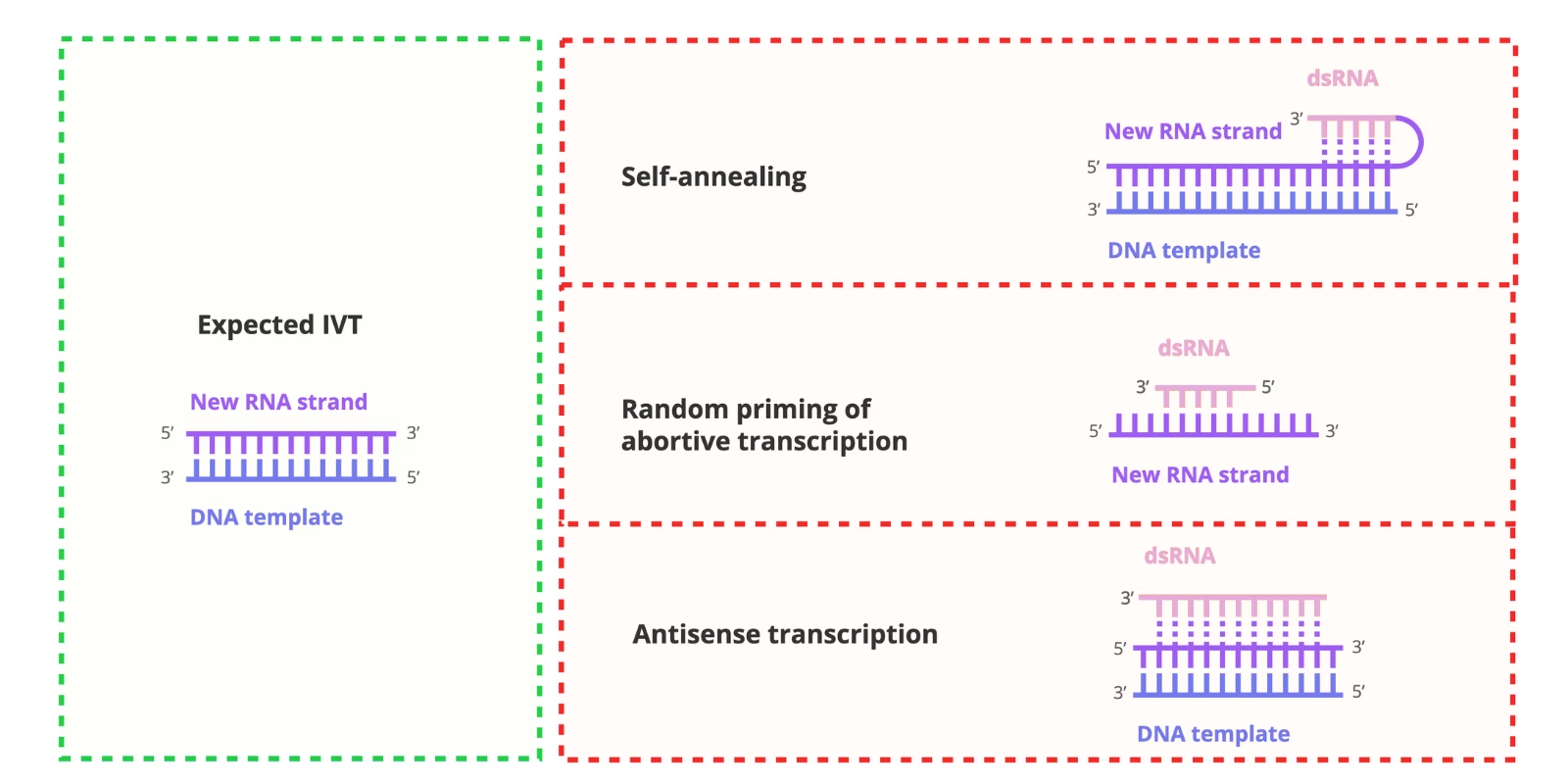
In IVT-based manufacturing, dsRNA forms unintentionally. It may appear as:
- Short internal duplex regions within a primarily single-stranded transcript
- Hybridized antisense transcripts
- Longer duplex contaminants generated during transcription
Importantly, dsRNA formation exists on a spectrum rather than as a binary presence or absence. Even low-abundance duplex structures can be biologically active depending on length, concentration, and route of administration. That is why dsRNA should be treated as a structurally heterogeneous impurity rather than a single molecular species.
Mechanisms of dsRNA formation during IVT
dsRNA formation arises from polymerase behavior, template design, and reaction conditions. T7 RNA polymerase, the most widely used enzyme for IVT, is highly processive but prone to byproduct formation under certain sequence and kinetic conditions.
Mechanistic contributors include:
- Self-complementary regions in the RNA sequence that fold into stable secondary structures
- Antisense transcription from template-independent initiation events
- Template switching during elongation
- Abortive transcripts that anneal to full-length RNA
- Read-through transcription beyond linearization sites
Magnesium concentration, nucleotide triphosphate (NTP) ratios, template purity, reaction time, and temperature all influence duplex formation kinetics.
In practice, longer GC-rich regions and high local complementarity increase duplex stability, particularly above ~30 base pairs, where immune sensing becomes more probable.
dsRNA formation reflects both sequence architecture and process physics; it is not eliminated by enzyme purity alone.
How Does dsRNA Activate Innate Immune Pathways?
Cells interpret dsRNA as a viral signature. Pattern recognition receptors detect duplex RNA in a length-dependent manner.
Major sensors include toll-like receptor 3 (TLR3) in endosomes, tetinoic acid–inducible gene I (RIG-I), melanoma differentiation-associated protein 5 (MDA5) and protein kinase R (PKR).
PKR activation occurs when dsRNA exceeds approximately 30 base pairs, leading to phosphorylation of eukaryotic initiation factor 2 alpha (eIF2α), which suppresses global translation. MDA5 preferentially recognizes long duplex RNA, while RIG-I detects shorter duplex regions with specific end structures.
Downstream signaling includes type I interferon production, nuclear factor kappa B (NF-κB) activation, pro-inflammatory cytokine release and translational arrest.
The consequence for RNA therapeutics is that unintended dsRNA can reduce protein expression, increase reactogenicity, and alter pharmacodynamic behavior, particularly in repeat-dose regimens.
Impact on translation efficiency and potency
dsRNA reduces translation both indirectly and directly. Indirectly, activation of PKR leads to phosphorylation of eIF2α, which inhibits translation initiation. Directly, dsRNA activates the 2′-5′-oligoadenylate synthetase (OAS) pathway, producing 2-5A molecules that activate RNase L and promote RNA degradation.
Additional cellular responses include stress granule formation, reduced ribosomal loading and enhanced RNA decay. Even low-percentage dsRNA contamination has been shown to significantly reduce in vitro translation efficiency in mRNA constructs.
Presence of dsRNA affects apparent potency and dose–response relationships, not only safety.
How does dsRNA influence batch-to-batch variability?
As IVT processes scale from research to GMP production, dsRNA control becomes a reproducibility challenge as much as a biological one. Several variables drive dsRNA accumulation across batches: incomplete DNA template linearization exposes non-target sequences that promote antisense transcription; extended IVT reaction times allow secondary polymerase activity to generate longer duplex byproducts; and polymerase lot-to-lot differences in processivity or fidelity shift the ratio of full-length to aberrant transcripts.
Downstream, purification stringency and chromatographic resolution determine how much residual dsRNA survives into the drug substance.
At manufacturing scale, changes in mixing kinetics and heat distribution can further amplify duplex formation in ways that are difficult to predict from bench-scale data. When dsRNA levels are not tightly controlled, the consequences extend beyond immunogenicity risk: potency drift across lots, increased comparability burden during process changes, and regulatory questions around impurity consistency all follow.
Analytical Strategies for dsRNA Detection
No single analytical method captures all dsRNA species. Assays differ in structural recognition, size sensitivity, and quantification capability.
| Category | Output | Strengths | Limitations |
|---|---|---|---|
|
Immunoassay: J2 ELISA |
Quantitative dsRNA level |
Sensitive; GMP-compatible |
Length/structure bias; reference-dependent |
|
Screening: J2 Dot Blot |
Semi-quantitative signal |
Fast; low complexity |
Limited precision; narrow dynamic range |
|
Chromatography: IP-RP HPLC |
Peak separation; relative quantification |
Integrates with impurity profiling |
Resolution-dependent; possible co-elution |
|
Electrophoresis: CE |
Size distribution profile |
Orthogonal integrity check |
Not duplex-specific |
|
Sequencing: NGS |
Transcript identity + antisense content |
High mechanistic resolution |
Indirect duplex inference; bioinformatics required |
|
dsRNA standard: 500–1500 bp; ± modifications |
Known length and sequence |
Calibration, LOD/LOQ validation, benchmarking |
Not a detection method; must pair with assay |
What are dsRNA standards?
Accurate dsRNA quantification requires a calibrated reference material. A dsRNA reference standard is a well-characterized duplex RNA preparation of defined length used to construct calibration curves, benchmark assay sensitivity, and enable cross-platform or inter-laboratory comparison. Without one, reported dsRNA values are relative rather than absolute.
Commercially available dsRNA ladders contain duplex fragments of defined sizes and are commonly used to confirm that an assay detects dsRNA across the biologically relevant size range, including fragments above ~30 base pairs where PKR and MDA5 activation becomes probable.
Synthetic single-length duplex RNA can serve as a more precise point calibrator for specific assay formats such as the J2 monoclonal antibody-based ELISA. Where regulatory-grade reference materials are unavailable (which remains common in this field) sponsors typically qualify in-house standards using orthogonal methods and document the characterization in their analytical validation package.
Reliable quantification requires calibrated reference materials. In the absence of standardized dsRNA reference materials, inter-laboratory comparison becomes difficult.
Regulatory Expectations for dsRNA Control
No global regulatory authority has established a universal numeric dsRNA threshold for RNA therapeutics, but impurity characterization, analytical validation, and comparability requirements under frameworks such as ICH Q5E apply whenever process changes occur .
Frequently Asked Questions (FAQ)
1. Can you avoid dsRNA in IVT processes?
No. dsRNA formation is intrinsic to polymerase kinetics and sequence design, but levels can be reduced through optimized reaction conditions and purification.
2. Does every dsRNA fragment trigger immune activation?
Immune activation is length- and structure-dependent. Hairpin regions above approximately 30 base pairs, such as those found on most dsRNA impurities, are very likely to activate immune responses (PKR and MDA5 pathways).
3. Is J2 ELISA sufficient for GMP release testing?
J2-based assays are widely used, but suitability depends on validation data, size detection limits, and specification rationale.
4. Should dsRNA always be designated as a CQA?
Not universally. CQA status depends on demonstrated impact on potency or safety within a defined product context.
5. Does purification fully eliminate dsRNA?
Chromatographic purification significantly reduces dsRNA but rarely eliminates all duplex structures. Residual levels depend on process robustness.
6. Are regulatory agencies harmonized on dsRNA expectations?
Global expectations converge on impurity characterization principles, but region-specific guidance may differ in detail