
The best Cas9 mRNA for gene editing is defined by five measurable quality attributes: transcript integrity, double-stranded RNA (dsRNA) content, capping efficiency, nucleotide modification strategy, and functional validation in a cell-based potency assay. Each attribute directly determines translation efficiency, immune activation, and editing reproducibility.
For researchers performing ex vivo or in vivo CRISPR editing, understanding these parameters, and knowing which thresholds to require from a supplier, is the difference between consistent results and unexplained variability.
This guide covers: what makes Cas9 it technically demanding to manufacture, which quality attributes govern editing performance, how to evaluate supplier specifications, and how RNA quality explains editing reproducibility and why Cas9 mRNA is selected over plasmid or viral delivery. It is written for groups evaluating Cas9 mRNA for gene editing workflows, from guide optimization through early IND-enabling studies.
What Makes Cas9 mRNA Technically Challenging to Manufacture?
Selecting Cas9 mRNA from a supplier requires understanding why it is structurally demanding to produce. The quality attributes that matter most are all consequences of in vitro transcription (IVT) chemistry applied to a very large RNA molecule.
Large ORF (~4.2 kb) and IVT Complexity
The Streptococcus pyogenes Cas9 (SpCas9) coding sequence is approximately 4.2 kilobases (kb), excluding 5′ and 3′ untranslated regions (UTRs) and the poly(A) tail. This makes Cas9 mRNA substantially longer than most synthetic mRNAs.
Vaccine antigens such as influenza hemagglutinin (~1.7 kb) or the rabies virus glycoprotein (~1.6 kb), for instance, typically encode sequences under 2 kb. Long transcripts generated by IVT are more prone to truncation events, intramolecular secondary structure formation, template switching artifacts, and dsRNA byproduct generation. Each of these impurity types independently reduces effective Cas9 protein yield and can confound editing results in ways that are difficult to attribute without supplier batch data.
dsRNA Formation During IVT
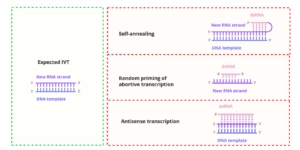
Double-stranded RNA can form during IVT through self-complementary regions in the Cas9 transcript or through aberrant polymerase activity, including run-on synthesis beyond the template end. dsRNA can jeopardize your project by activating innate immune pathways present in virtually all mammalian cell types. Activation of these pathways induces type I interferon responses that suppress global translation and may reduce cell viability. Even low dsRNA percentages can significantly alter protein expression in sensitive primary cells.
Quantitatively, typical unoptimized IVT products may contain detectable dsRNA at levels exceeding 1% of total RNA mass, measured by enzyme-linked immunosorbent assay (ELISA) using anti-dsRNA antibody (clone J2). High-purity Cas9 mRNA specifications target dsRNA below 0.1% under the same assay conditions. This tenfold or greater difference in dsRNA content can translate into substantial differences in Cas9 protein yield and downstream editing efficiency, particularly in primary T cells and hematopoietic stem and progenitor cells (HSPCs).
Capping Efficiency and Translation Kinetics
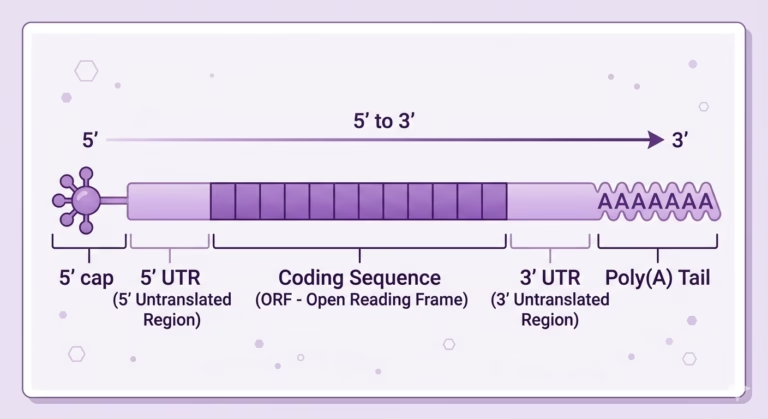
The 5′ cap structure enables ribosome recruitment via the eIF4F complex. Cap 1 structures are associated with improved translation efficiency and reduced innate immune recognition compared to Cap 0 structures [6]. Capping efficiency above 95% is the standard target for research-grade and IND-aligned Cas9 mRNA to ensure consistent ribosome loading across batches. Suboptimal capping (70–80% efficiency) leads to reduced Cas9 protein yield even when RNA integrity appears acceptable by electrophoresis. This is a common source of batch-to-batch variability that is missed when suppliers report integrity alone without capping data.
Nucleotide Modification: Why m1Ψ Matters
Incorporation of N(1)-methyl-pseudouridine (m1Ψ) in place of uridine is the most widely adopted modification strategy for therapeutic and research-grade mRNA. m1Ψ reduces recognition by Toll-like receptors (TLR7, TLR8) and cytoplasmic RNA sensors, decreasing innate immune activation while simultaneously enhancing translational output. For Cas9 mRNA specifically, this translates into higher nuclease protein levels per microgram of delivered RNA and a more controlled immune environment during editing, which is relevant for both ex vivo and in vivo applications.
Poly(A) Length and UTR Design
Untranslated regions and poly(A) tail length influence mRNA stability and translation rate. Engineered 5′ UTRs that minimize secondary structure and include an optimal Kozak context, combined with 3′ UTRs resistant to exonuclease degradation, can extend functional mRNA half-life and improve ribosome loading without prolonging nuclease exposure beyond the desired editing window. Poly(A) tails of 100–150 adenosines are standard for optimized mRNA constructs; shorter tails accelerate deadenylation-dependent degradation and reduce the duration and magnitude of Cas9 expression.
Which Quality Attributes Directly Influence Gene Editing Performance?
Cas9 mRNA performance is predictable when quality attributes are measurable, specified, and controlled at the supplier level. The following are the attributes required in a Certificate of Analysis (CoA) or Technical Data Sheet before committing to a supplier.
Transcript integrity above 90% full-length, measured by capillary electrophoresis (CE), ensures sufficient production of intact Cas9 protein. Truncated species cannot produce functional nuclease and increase replicate variability in ways that are difficult to troubleshoot without supplier batch data.
Capping efficiency above 95% Cap 1, confirmed by LC-MS or RP-HPLC, ensures consistent ribosome loading across batches. This attribute is frequently absent from supplier CoAs and is one of the most common sources of batch-to-batch variability in Cas9 protein yield.
Poly(A) tail length of 100–150 nucleotides supports mRNA stability and sustained Cas9 expression through the editing window. Tails shorter than ~80 nucleotides accelerate deadenylation-dependent decay and can compress nuclease exposure below what is needed for efficient cleavage, particularly in slowly dividing primary cells.
dsRNA content below 0.1% supports reduced interferon activation, improved primary cell viability, and higher editing reproducibility. When evaluating supplier CoAs, confirm that both the specified limit and the detection method. dsRNA ladders are the reference standard used to quantify dsRNA.
Endotoxin below 5 EU/mg is the standard research-grade threshold; protocols involving primary T cells or HSPCs may require below 1 EU/mg to avoid NF-κB activation independent of the RNA itself.
Functional potency must be validated in a cell-based assay. A CoA that confirms identity and purity does not confirm that the RNA translates into active nuclease. Batch-specific potency data is the only result that bridges specification and biological outcome. For Cas9 mRNA this includes, protein expression and editing efficiency in a defined cell model.
| Quality Attributes | Quality Control Method | Release Standard |
|---|---|---|
|
Identity |
Sequencing |
Sequence fully match |
|
Integrity/Purity |
Capillary electrophoresis |
>90.0% |
|
Capping Efficiency |
LC-MS |
>95.0% |
|
dsRNA |
ELISA |
<0.1% |
|
Endotoxin |
LAL assay |
<5 EU/mg |
|
Poly(A) tail length |
CE or sequencing |
100–150 nucleotides |
|
Potency |
Cell-based editing assay |
Supplier-defined with batch data |
What to Ask When Sourcing Cas9 mRNA:
Not all Cas9 mRNA suppliers provide the same level of analytical transparency. Before selecting a supplier for any editing program, the following questions should have clear, data-backed answers:
- What is the measured capping efficiency per batch, and is Cap 1 chemistry confirmed by LC-MS or equivalent?
- What are the specified dsRNA levels, and which detection method and antibody clone were used?
- How is transcript integrity assessed, and what is the acceptance criterion for full-length transcript percentage?
- Are endotoxin limits defined and validated for the cell types relevant to your application?
- Is functional potency validated in a cell-based editing assay, and is batch-specific data available before purchase?
- Is manufacturing reproducible lot-to-lot, with CoA data available for review
- What nucleotide modification strategy is used (unmodified, m1Ψ, pseudouridine), and has it been validated for your intended cell type?
Suppliers who cannot provide batch-specific dsRNA quantitation or capping efficiency data are transferring analytical risk to your laboratory. Clear answers to these questions materially reduce downstream experimental uncertainty.
Frequently asked questions
What is the typical length of Cas9 mRNA?
The Streptococcus pyogenes Cas9 (SpCas9) coding sequence is approximately 4.2 kb. The complete mRNA construct, including 5′ and 3′ UTRs and a poly(A) tail of approximately 120–150 nucleotides, typically results in a transcript of 4.5–4.7 kb. This length is substantially greater than most synthetic mRNA applications and is the primary reason Cas9 mRNA is more susceptible to truncation and dsRNA byproduct formation during IVT.
What dsRNA level is acceptable for Cas9 mRNA?
High-purity specifications typically target dsRNA below 0.1% of total RNA mass, measured by ELISA with anti-dsRNA antibody (clone J2). However, the acceptable limit depends on the application, cell type, and assay sensitivity. In highly sensitive primary cells such as T cells, NK cells, and HSPCs, even levels between 0.1% and 0.5% may cause measurable interferon activation and translation suppression. Research-grade catalog products may specify broader limits; users should request batch data and evaluate against their application requirements.
Why is m1Ψ used in Cas9 mRNA instead of standard uridine?
N(1)-methyl-pseudouridine reduces recognition by pattern recognition receptors including TLR7, TLR8, and RIG-I. This modification decreases innate immune activation following transfection and simultaneously enhances ribosome association and translation elongation rate. For Cas9 mRNA, the practical consequence is higher functional nuclease yield per microgram of delivered RNA and a more controlled cellular environment during editing. Fully unmodified Cas9 mRNA can be used in some applications but typically produces more variable results in primary human cells.
Does higher capping efficiency always improve editing outcomes?
High capping efficiency (>95%) generally supports stronger and more consistent Cas9 protein translation. However, in highly active cell lines, excessive Cas9 expression may trigger DNA damage response pathways due to accumulation of double-strand breaks, potentially compromising cell viability. The appropriate expression level depends on the target cell type, delivery dose, and gRNA:Cas9 molar ratio. High capping efficiency ensures that the specified dose is actually delivered to ribosomes; it does not remove the need for dose optimization.
Is Cas9 mRNA suitable for in vivo delivery?
Yes. Cas9 mRNA is compatible with LNP delivery systems and has been used for in vivo gene editing in preclinical models targeting the liver, lung, and other tissues. The transient expression profile is advantageous for in vivo applications where prolonged systemic nuclease activity poses safety concerns. Co-formulation of Cas9 mRNA with gRNA in a single LNP particle is the standard approach; formulation parameters including lipid composition, N/P ratio, and particle size require optimization for each delivery target.
How do I determine whether integrity problems or dsRNA problems are causing variable editing results?
These two impurity types produce distinct phenotypic signatures. dsRNA contamination primarily causes translational suppression and cell stress: reduced Cas9 protein expression, elevated interferon response markers, and reduced cell viability (without necessarily altering the CE integrity profile). Truncation artifacts reduce the proportion of full-length transcript capable of encoding complete Cas9 protein, presenting as reduced apparent protein size on western blot alongside reduced editing efficiency, with relatively normal cell viability. Requesting both CE integrity data and dsRNA quantitation for each batch enables cleaner root cause analysis.
Can the same Cas9 mRNA lot be used across multiple guide RNAs?
Yes. Cas9 mRNA quality attributes are independent of the guide RNA sequence. A single validated Cas9 mRNA batch can be co-delivered with multiple synthetic gRNAs across parallel experiments, provided consistent dosing and delivery conditions are maintained. This is one of the workflow advantages of mRNA-based Cas9 over RNP formats, which require fresh protein–gRNA complexation for each guide variant.
What distinguishes a research-grade Cas9 mRNA from one suitable for IND-enabling studies?
Research-grade Cas9 mRNA is manufactured under quality practices appropriate for laboratory use, with specifications focused on functional performance. IND-enabling studies require materials manufactured under a quality system that supports regulatory submission: raw material traceability, controlled process parameters, formal batch records, specification-based release testing, and stability data. Analytical thresholds for dsRNA, endotoxin, and integrity are typically the same or tighter, but process controls and documentation requirements are substantially more extensive. Transitioning to GMP-aligned materials requires early planning to avoid program delays.
References
1] Hsu PD, Scott DA, Weinstein JA, et al. DNA targeting specificity of RNA-guided Cas9 nucleases. Nature Biotechnology. 2013;31(9):827–832. https://doi.org/10.1038/nbt.2647
[2] Pardi N, Hogan MJ, Porter FW, Weissman D. mRNA vaccines — a new era in vaccinology. Nature Reviews Drug Discovery. 2018;17(4):261–279. https://doi.org/10.1038/nrd.2017.243
[3] Mu X, Hur S. Immunogenicity of in vitro-transcribed RNA. Accounts of Chemical Research. 2021;54(21):4012–4023. https://doi.org/10.1021/acs.accounts.1c00521
[4] Kato H, Takeuchi O, Sato S, et al. Differential roles of MDA5 and RIG-I helicases in the recognition of RNA viruses. Nature. 2006;441(7089):101–105. https://doi.org/10.1038/nature04734
[5] Karikó K, Buckstein M, Ni H, Weissman D. Suppression of RNA recognition by Toll-like receptors: the impact of nucleoside modification and the evolutionary origin of RNA. Immunity. 2005;23(2):165–175. https://doi.org/10.1016/j.immuni.2005.06.008
[6] Furuichi Y, Shatkin AJ. Viral and cellular mRNA capping: past and prospects. Advances in Virus Research.2000;55:135–184. https://doi.org/10.1016/S0065-3527(00)55003-9